

Red Yeast Rice and Cholesterol
June 17, 2009 Written by JP [Font too small?]Anniversaries are occasions to celebrate and reflect upon special times in our lives, typically relationships, weddings or work related milestones. But these occasions also occur in the field of medicine. In 1999, research began appearing in medical journals on a culinary substance known as red yeast rice (RYR), a richly pigmented paste or powder that is commonly used to add color to Chinese and East Asian foods. It has also been used in the traditional practice of Chinese medicine for over 1,000 years to support healthy digestion and proper circulation. The reason for the modern Western interest in RYR has to do with its similarity to a relatively new class of cholesterol lowering drugs known as “statins”.

Red yeast rice contains a group of chemicals called monacolins. Monacolin K is chemically identical to lovastatin, which is sold as a prescription medication (Mevacor). The difference between Mevacor and RYR is that RYR also contains many other natural substances such as fatty acids, antioxidant-rich pigments and tannins, phytochemicals and trace minerals. (1,2) Because of the chemically diverse makeup of RYR, there was hope that it would provide an effective and safer alternative to the more expensive and controversial statins. What’s been learned in the last decade helps to clarify the promise and reality of this nutritional supplement.
The most recent inquiry into the cardiovascular effects of red yeast rice appear in the June edition of the journal Annals of Internal Medicine. In that trial, 62 volunteers with high cholesterol split into two groups. One group received a total of 3,600 mg of RYR (1,800 mg twice daily) and the remainder of the participants were given identical looking placebos. All of the volunteers also engaged in a “12-week therapeutic lifestyle change program”. Blood tests were performed pre, during and post study to test the efficacy and safety of RYR versus a benign placebo. Here’s what the researchers discovered:
- LDL (“bad”) cholesterol levels dropped by an average of 43 mg/dl at the 12 week mark and 35 mg/dl after 24 weeks. The 8 mg/dl change at the 24 week point may indicate that the addition of the lifestyle program lead to an additive cholesterol lowering effect.
- HDL (“good”) cholesterol and triglyceride levels and all measures of toxicity (liver enzymes and pain scores) were comparable in the RYR and placebo groups.
The authors of the study concluded that, “Red yeast rice and therapeutic lifestyle change decrease LDL cholesterol level without increasing CPK or pain levels and may be a treatment option for dyslipidemic patients who cannot tolerate statin therapy.” CPK is a marker that indicates muscle damage (myalgia), a potential side effect of statin therapy. (3)
Previous studies utilizing RYR have demonstrated even more impressive reductions in LDL and total cholesterol, inflammatory markers and triglycerides. (4,5,6,7,8) However, the results have been rather erratic. This may be due to differences in how manufacturers grow RYR. The basic process involves inoculating rice with a specific mold, usually Monascus purpureus. But due to quality and safety concerns, other molds may also be employed, such as Monascus pilosus. (9,10)
The issue of safety is a very real consideration for those considering red yeast rice. As I mentioned, the similarity to Mevacor, the statin medication, immediately sends off alarms for some medical authorities. There is preliminary evidence that these concerns are justified. No widespread side effects have yet been documented, but some case reports hint at the possibility that RYR may not be appropriate for people with compromised liver function, previous indications of myopathy (muscle damage) and other health vulnerabilities. (11,12,13)
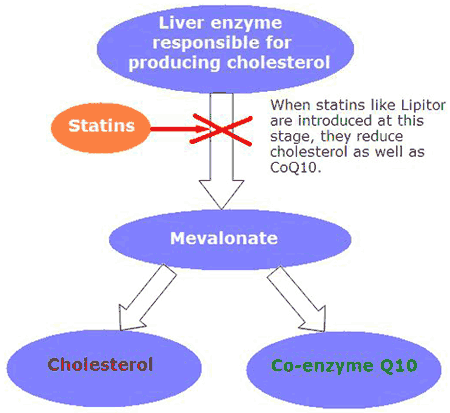
Some of the potential danger may be offset by supplementing simultaneously with the antioxidant CoQ10. Statin medications (including RYR) seem to interfere with the body’s ability to produce CoQ10. (14) This is a very important observation because CoQ10 appears to play a valuable role in promoting cardiovascular health. In addition, CoQ10 is present in all of the tissues that can be adversely affected by statin therapy, such as the heart, liver and muscular system. If that’s not reason enough to recommend CoQ10 while using statins, it’s been recently suggested that their combined use may provide a synergistic antioxidant effect in the heart and throughout the body. (15) This theory is supported by a new study in the journal Diabetes Care that found that adding CoQ10 in statin-treated patients improved endothelial function. (16)
On the positive side of the safety issue, there was a trial published in 2008 that followed almost 5,000 people for an average of 4.5. years. In that research, a 45% reduced risk of heart attack and death was found in the participants using RYR. Total mortality (from all forms of death) was also 33% lower in the RYR group. Furthermore, the group that consumed RYR daily experienced reductions in LDL cholesterol and triglycerides, and a 33% decrease in the need for heart-related surgery. That particular investigation also found an improvement in HDL (“good”) cholesterol. (17,18)
If you decide to try RYR, please do so with the cooperation of your cardiologist or primary physician. It’s important to look out for any possible signs of adverse reactions such as digestive disturbances, liver abnormalities, memory problems and muscle pain. I would also seriously consider the use of CoQ10 while taking RYR or any statin. Because of a general lack of consistency in commercially available products, please ask plenty of questions before choosing a product. Then, make sure to have periodic blood tests to determine whether said product is working safely for you. Don’t take any unnecessary chances with your health.
Finally, if you’d prefer to use a different natural remedy to manage your cholesterol levels, consider flax seeds. A meta-analysis in the June issue of the American Journal of Clinical Nutrition reviewed 28 studies over the past two decades and determined that flax lignans and seeds could significantly reduce LDL, total cholesterol and improve insulin sensitivity. The effects were more pronounced in postmenopausal women, but other studies have found benefits for both sexes. (19,20,21)
Note: Please check out the “Comments & Updates” section of this blog – at the bottom of the page. You can find the latest research about this topic there!
Be well!
JP
Tags: Cholesterol, Heart Health, Red Yeast Rice
Posted in Food and Drink, Heart Health, Nutritional Supplements
June 18th, 2009 at 7:00 am
Excellent article! RYR has become quite popular as a natural means of lowering cholesterol. This article explains the similar modality of RYR to common statin drugs. Most importantly, we should all be aware of possible similar side effects and the value of supplementing with a good quality CoQ10. RYR is an excellent choice when monitored through a physician’s care.
June 18th, 2009 at 11:01 am
Thank you for your comments, Robin.
Be well!
JP
August 10th, 2009 at 4:40 pm
Very informative post. I was just reading up on red yeast rice. I think it’s a real shame that the pharmaceutical companies put all the pressure on the natural supplement people in order to keep them from selling their red yeast rice supplements. Just because it has a chemical sort of like lovastatin…
Again, very nice post.
August 10th, 2009 at 5:03 pm
Thank you, George. 🙂
Be well!
JP
October 28th, 2010 at 1:57 pm
Jonathan, are these red yeast rice hulled or unhulled. Have tweeted but will share via Facebook and Digg it!
October 29th, 2010 at 12:22 pm
Kelly,
Please take a look at this link (below). It describes the red yeast rice production process:
http://en.wikipedia.org/wiki/Red_yeast_rice
However, it’s important to note that red yeast rice supplements are quite different than the traditional food form. For cholesterol lowering purposes, a reputable RYR supplement would likely be more effective and practical.
JP
November 27th, 2010 at 10:00 pm
Do you think that cranberries work the same way?
I’ve been dealing with high LDL since a few years. I felt the need to take control of my health. I didn’t even know about the cholesterol lingo. Thanks to Google, I now understand my cholesterol levels.
Plus that chicken looks yummy!
November 27th, 2010 at 10:53 pm
Fred,
Certain cranberry extracts may lower LDL cholesterol. However, their exact mechanism of action isn’t fully established at this time:
https://www.healthyfellow.com/471/cranberry-heart-therapy/
http://onlinelibrary.wiley.com/doi/10.1111/j.1464-5491.2008.02588.x/abstract
http://journals.cambridge.org/action/displayFulltext?type=6&fid=927296&jid=BJN&volumeId=96&issueId=02&aid=927292&bodyId=&membershipNumber=&societyETOCSession=&fulltextType=RA&fileId=S0007114506002145
http://www.sciencedirect.com/science?_ob=ArticleURL&_udi=B6T99-4GGWJ1K-1&_user=10&_coverDate=08%2F26%2F2005&_rdoc=1&_fmt=high&_orig=search&_origin=search&_sort=d&_docanchor=&view=c&_acct=C000050221&_version=1&_urlVersion=0&_userid=10&md5=2fe1e8f801265bce0debd6db863a2c6f&searchtype=a
http://www.ncbi.nlm.nih.gov/pubmed/12058989
Be well!
JP
April 20th, 2015 at 1:52 pm
Update 04/20/15:
http://www.biomedcentral.com/1472-6882/15/52
BMC Complementary and Alternative Medicine 2015, 15:52
Can red yeast rice and olive extract improve lipid profile and cardiovascular risk in metabolic syndrome?: A double blind, placebo controlled randomized trial
Background: Metabolic syndrome (MetS) comprises a spectrum of clinical phenotypes in which dyslipidemia, dysglycemia and hypertension are clustered and where all share a high level of oxidative stress and an increased risk of cardiovascular disease. This study examines the effect of a nutritional supplement combining red yeast rice and olive fruit extract on the lipid profile and on oxidative stress in a population of patients with MetS.
Methods: In a double blind placebo controlled randomized trial, 50 persons with MetS, as defined by the ATPIII criteria, received the study product or placebo for 8 weeks. The study product contained 10.82 mg of monacolins and 9,32 mg of hydroxytyrosol per capsule, and is commercialized as Cholesfytol plus. The primary outcome measure was the difference in LDL reduction between intervention and control groups. Furthermore, differences in changes of CH, HDL, ApoA1, ApoB, HbA1c and oxLDL were measured, as well as side-effects, CK elevation, changes in clinical parameters and in cardiovascular risk.
Results: In the intervention group, LDL cholesterol was lowered by 24% whereas it increased by 1% in the control group (p < 0.001). Other effects observed were a change in total cholesterol (−17% in the intervention group vs +2% in the control group, p < 0.001), apolipoprotein B (−15% vs +6%, p < 0.001), and TG (−9% vs + 16%, p = 0.02). Oxidized LDL decreased by 20% vs an increase of 5% in the control group (p < 0.001). Systolic and diastolic arterial blood pressure decreased significantly by 10 mmHg (vs 0% in the control group, p = 0.001) and 7 mmHg (vs 0% in the control group, p = 0.05) respectively. One person in the intervention group, who suffered from Segawa’s syndrome, dropped out because of severe muscle ache. Conclusions: The combination of active products in this study may be an alternative approach to statins in people who do not need, or cannot or do not want to be treated with chemical statins. Side effects, effects on oxidative stress and on glucose metabolism need to be examined more thoroughly. Be well! JP
April 10th, 2016 at 5:54 pm
Updated 04/10/16:
http://www.karger.com/Article/Abstract/445359
Ann Nutr Metab. 2016 Apr 8;68(3):213-219.
Middle-Term Dietary Supplementation with Red Yeast Rice Plus Coenzyme Q10 Improves Lipid Pattern, Endothelial Reactivity and Arterial Stiffness in Moderately Hypercholesterolemic Subjects.
AIM: The aim of our study was to investigate whether treatment with red yeast rice added with Coenzyme Q10 is associated with changes in endothelial function and arterial stiffness.
METHODS: This double blind, placebo-controlled, randomized clinical trial was carried out on 40 non-smoker moderately hypercholesterolemic subjects (ClinicalTrial.gov ID NCT02492464). After 4 weeks of diet and physical activity, patients were allocated to treatment with placebo or with an active product containing 10 mg monacolins and 30 mg Coenzyme Q10, to be assumed for 6 months. Endothelial reactivity and arterial stiffness have been measured through the validated Vicorder® device.
RESULTS: During monacolin treatment, patients experienced a more favorable percentage change in low density lipoprotein (LDL)-cholesterol (after monacolin treatment: -26.3%; after placebo treatment: +3.4%, p < 0.05). Endothelial reactivity (pulse volume displacement after monacolin treatment: +6.0%; after placebo treatment: -0.3%, p < 0.05), and arterial stiffness (pulse wave velocity (PWV) after monacolin treatment: -4.7%; after placebo: +1.1%, p < 0.05) also significantly improved only after monacolin treatment. CONCLUSION: The long-term assumption of the tested dietary supplement is associated with an improvement in LDL-cholesterolemia, endothelial reactivity and PWV in moderately hypercholesterolemic subjects. Be well! JP
August 13th, 2016 at 10:40 pm
Updated 08/13/16:
http://www.ncbi.nlm.nih.gov/pubmed/27508588
J Hypertens. 2016 Sep;34 Suppl 2:e109-10.
[OP.8E.07] MIDDLE-TERM DIETARY SUPPLEMENTATION WITH RED YEAST RICE PLUS COENZYME Q10 IMPROVES LIPID PATTERN, ENDOTHELIAL REACTIVITY AND ARTERIAL STIFFNESS IN MODERATELY HYPERCHOLESTEROLEMICS.
OBJECTIVE: Red yeast rice is a well-known lipid-lowering nutraceutical. The aim of this double-blind, randomized, placebo-controlled, clinical trial was to investigate if the known benefits on lipid pattern of a 6-month treatment with 10 mg monacolins could be also associated to changes in endothelial function and arterial stiffness.
DESIGN AND METHOD: This double blind, placebo-controlled, randomized clinical trial was carried out on 40 moderately hypercholesterolemic subjects, non smokers, pharmacologically untreated, in primary prevention for cardiovascular diseases (Clinicaltrial.gov ID NCT02492464).After 4 weeks of diet and physical activity, patients were allocated to treatment with an indistinguishable pill of placebo or with an active product containing 10 mg monacolins from Monascus purpureus and 50 mg coenzyme Q10 to be assumed for 6 months.Endothelial reactivity and arterial stiffness have been measured through the validated Vicorder® device.
RESULTS: When compared to the placebo phase, during monacolin treatment patients experienced a more favorable percentage change in LDL-cholesterol (LDL after monacolin treatment: -27.7%; LDL after placebo treatment: +5.0%, p < 0.05).As it regards the vascular parameters, endothelial reactivity (pulse volume displacement after monacolin treatment: +6.0%; pulse volume displacement after placebo treatment: +0.5%, p < 0.05), and arterial stiffness (pulse wave velocity after monacolin treatment: -0.4%; pulse wave velocity after placebo: +0.1%, p < 0.05) also significantly improved after monacolin treatment only. CONCLUSIONS: Based on our data, the long-term assumption of a red yeast rice dietary supplement containing 10 mg monakolins per daily dose seems to be associated to an improvement of LDL-cholesterolemia, endothelial reactivity and pulse wave velocity in moderately hypercholesterolemic subjects. Be well! JP
June 24th, 2017 at 3:38 pm
Updated 06/24/17:
https://www.ncbi.nlm.nih.gov/pubmed/28641460
Eur J Prev Cardiol. 2017 Jan 1:2047487317715714.
Variability in strength of red yeast rice supplements purchased from mainstream retailers.
The United States Food and Drug Administration (FDA) has introduced manufacturing standards for dietary supplements, including red yeast rice, to assure their identity, purity, strength, and composition. One supplement commonly used to self-treat high cholesterol, red yeast rice, may contain monacolin K, an ingredient identical to prescription lovastatin. We examined whether FDA’s manufacturing standards led to standard concentrations of the statin monacolin K in red yeast rice supplements. We analyzed 28 brands of red yeast rice supplements by ultra-high performance liquid chromatography-diode array detector-quadrupole time-of-flight mass spectrometry for monacolin K content. Monacolin K was not detected in two brands. In the 26 brands that contained monacolin K, the quantity ranged more than 60-fold from 0.09 to 5.48 mg per 1200 mg of red yeast rice. Following the manufacturers’ recommendations for daily servings, the quantity of monacolin K consumed per day would range more than 120-fold from 0.09 to 10.94 mg. Despite FDA manufacturing standards, strength and composition of red yeast rice supplements sold at mainstream retail stores in the United States remains unpredictable.
Be well!
JP