

Plastic Chemical Danger
January 19, 2010 Written by JP [Font too small?]There’s a poignant scene in the film The Shawshank Redemption where an old prisoner is set free into a world that hardly resembles the one he left behind. Automobiles whiz past him as he tries to cross the street. His parole appointed job is at a fast paced market unlike any small town grocery store from his youth. It seems the whole world got in a great big hurry while he was away and he doesn’t like one bit. The speed of modern life is ever increasing. It’s hard to say how exactly this trend started. But it’s safe to say that at this point it’s driven primarily by consumer demand. A large enough segment of the population wants products and services that bring convenience home and streamline the many details that make up daily living.

In the 21st century, it’s hard to imagine a world in which plastic wouldn’t play a major role. After all, we drink from plastic bottles and wash our hair with shampoo that comes in similar looking containers. Our cars, phones, sunglasses and even the keyboards we type on are all made of this chemical compound. We are surrounded by plastic and what’s more, we’re happily hooked on it. That’s all good and well except for one thing: it may be harming us in unexpected ways. Today I’m going to focus on some recent findings on how chemicals in plastic may be altering the physiology and psychology of children throughout the world.
Phthalates are a variety of chemicals used to make plastic more flexible. They are commonly found in plastic wraps that are used to cover foods such as cheeses, meats and vegetables. But phthalates can also be present in cleaning items, personal care products, tubing and, most disturbingly, in toys. Many animal studies and some human studies have linked these specific elements to a variety of health conditions ranging from asthma to autism to birth defects to hormonal abnormalities and even obesity. Now, a new Korean trial has found a troubling association between phthalate concentrations and attention deficit hyperactivity disorder (ADHD) in children between the ages of 8-11. Urine tests were used to quantify the levels of this chemical in a group of 261 boys and girls. Those with the largest amounts of phthalates exhibited the most pronounced ADHD symptoms based on computerized tests and teacher reports that measured attention and impulsivity. The findings were described as presenting a “strong association between phthalate metabolites in urine and symptoms of ADHD”. (1,2,3,4,5,6)
A trial recently published in the International Journal of Andrology examined a proposed connection between elevated levels of phthalates in mothers’ prenatal urine and its subsequent affects on masculinity in preschool aged boys. A total of 145 children (aged 3.5 – 6.5) were included in this examination. Mothers who had higher prenatal levels of two phthalate metabolites (DBP and DEHP) generally had sons who exhibited less “male-typical behavior” such as fighting/”horsing around” and playing with trucks. The lead researcher of the study, Dr. Shanna H. Swan, theorized that phthalates may affect testosterone levels during a critical stage of male development in which sexual identity is formed. Previous studies have demonstrated a so called “phthalate syndrome” in male animals and boys which manifests in abnormal genital development. (7,8)
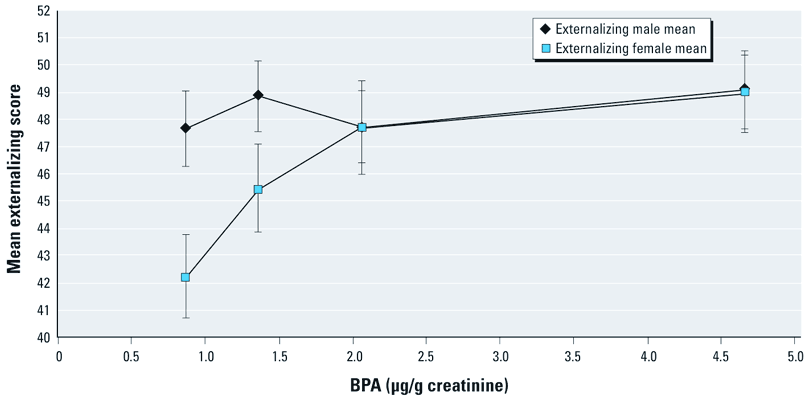
Bisphenol A (BPA) is another hormone disrupting chemical generally found in hard plastic products such as baby and water bottles, canned food linings and medical tubes. A report in the December issue of the journal Environmental Health Perspectives raises alarm about the effect of BPA in young girls. The source of BPA in these developing children is once again believed to be related to either prenatal exposure or a common environmental source that both mother and child share. A group of scientists examined prenatal urine samples from 249 women and compared them to the behavioral patterns of their related children. The mothers with the highest concentrations of BPA were more likely to have girls who were more aggressive and hyperactive at the age of 2 as compared to mothers with lower levels of BPA. One of the researchers commented that “girls whose mothers had higher BPA exposure were more likely to act like boys than girls”. (9)
Dr. Andrew Weil, a leader in the field of alternative and complementary medicine, offers some sage advice about how to lower BPA and phthalate exposure for adults and children alike in his Fall 2009 Healthy Eating Guide. Dr. Weil suggests: a) cooking and microwaving only in ceramic or glass containers; b) opting for BPA-free baby bottles and stainless steel water bottles; c) avoiding the use of plastic wrap and placing plastic-wrapped market items in more suitable containers (glass) once at home and; d) choosing packaged foods and oils in glass bottles rather than plastic bottles or lined cans.
There’s no turning back the clock or putting the genie back in its lamp. Plastic is here to stay, at least for the foreseeable future. But we do have options about how and when you we choose to use it. A good place to begin your plastic transformation is at home. Avoiding BPA and phthalates outside of your abode can be more challenging. When you’re out and about, the key is to simply make the best choices that are available to you. Another way to promote change in this arena is to purchase products that specifically avoid the use of such questionable chemicals. You’ll often find that manufacturers will mention this on product labels or in the accompanying literature because it can be a selling point to informed consumers. In the same way that we the people have demanded a more convenient and speedier world, we too can demand a safer place for our current and future generations.
Update – The FDA has just announced that it will re-examine the safety of bisphenol A due to recent studies that indicate “potential effects of BPA on the brain, behavior, and prostate gland in fetuses, infants and young children”. The Food and Drug Administration will be working with National Institutes of Health on more “in-depth studies to answer key questions and clarify uncertainties about the risks of BPA”. We now have a semi-official warning. Let’s make the most of it. (10)
Note: Please check out the “Comments & Updates” section of this blog – at the bottom of the page. You can find the latest research about this topic there!
Be well!
JP
Tags: ADHD, Detoxification, Testosterone
Posted in Children's Health, General Health, Women's Health
January 19th, 2010 at 10:50 pm
My mother once thought that plastics cause cancer.
Even a cancerous growth is called “aplastic.”
She wouldn’t even let me use a straw to drink from!
But it is good to know the really bad guy chemicals are being examined.
Good writing JP – Boys won’t be boys – clever!
January 19th, 2010 at 11:48 pm
Thanks, Anne! 🙂
Be well!
JP
January 20th, 2010 at 5:05 am
Morning JP!
hope you two had a very nice weekend.
avoiding plastic is one of the multiple reasons that we try to buy almost everything at our organic dealer (similar to your whole foods). i can buy there almost everything without plastic. the normal supermarkets pack everything in plastic (apples, bananas, mushrooms, meat, bread etc. )
one big problem of plastic is that it is not recyclable but it dissolves into very little parts in our oceans and fishes and other animals have plastic in their bodies and from there it came back to our digestive system. another point is the estrogenic effect of plastics – like you already mentioned above – it migrates into our foodstuff, bottled water etc.. electrical plastic tools from shaver to computer contain some chemicals which should provide fire protection (i mean that those tools do not easily burn) those chemicals are also very toxic and migrate also easily through our skin. the salty moisture film on our skin and fingertips solve those chemicals easily. hooray we are totally poisoned! 😉
Stay healthy 🙂
Nina K.
January 20th, 2010 at 1:20 pm
Good day, Nina! 🙂
It is indeed a relatively toxic world. But we can make it better in our own small way. The things that can’t be changed (or that change slowly) are best dealt with by protecting ourselves in every practical way available to us, IMO. Which is what you’re doing! Well done! 🙂
Be well!
JP
February 9th, 2010 at 8:45 am
“Many soft plastics contain different types of plasticizers, called phthalates, to keep products flexible. And there are growing concerns about phthalates as well.
Like BPA, phthalate compounds may sometimes act like hormones. Some researchers consider them endocrine disruptors, although the American Chemistry Council disagrees. Parents have been warned not to allow babies to chew on phthalate-containing soft plastic toys and to choose phthalate-free baby powder and lotions.
Another hidden source of phthalates can be pill coatings. Both over-the-counter and prescription drugs may be covered with phthalate-containing plastic. Every time you swallow such a pill your exposure increases dramatically. Researchers have found that phthalate levels can rise as much as 100 fold after a few months of taking such a medication (Environmental Health Perspectives, Feb. 2009).”
http://www.peoplespharmacy.com/2010/02/08/are-your-pills-poisoning-you-with-plastic/
February 9th, 2010 at 8:56 am
another scary link:
http://ehp.niehs.nih.gov/docs/2005/8100/abstract.html
February 9th, 2010 at 9:08 am
Medications as a Potential Source of Exposure to Phthalates in the U.S. Population:
http://ehsehplp03.niehs.nih.gov/article/fetchArticle.action?articleURI=info%3Adoi%2F10.1289%2Fehp.11766
February 9th, 2010 at 1:49 pm
Excellent information. Thanks for posting it, Iggy! 🙂
Be well!
JP
March 16th, 2010 at 8:19 am
hello,
right now i am disscissing with a person he is claiming that biodegradable plastics are more dangarous than plastics? can you explain it?? some european comapany and plastic center also claim it?
March 16th, 2010 at 2:54 pm
Rahul,
This may be what they’re hinting at:
http://blogs.discovermagazine.com/80beats/2009/08/21/plastic-is-more-biodegradable-than-we-thought-thats-bad/
Wherever possible, I suggest avoiding plastic – use ceramic, glass or metallic containers instead. More and more options are becoming available every day. This was exceedingly apparent at this year’s Natural Product Expo West this past weekend.
Be well!
JP
May 4th, 2010 at 1:06 pm
We throughly enjoyed reading this article! Glad to see that people are taking a growing initiative to learn and blog about these dangerous chemicals and their very real effects on us.
At C-S construction specialities, we have been working hard to eliminate the use of PVC, BPA, and PBT chemicals from our products. We have recently done so by re-releasing a product that is free of all such chemicals.
Your blog posts are of interest to us, well put together and concise. For more great articles and insight into chemically safe plastics and environmentally sustainable design, visit us at http://www.twitter.com/acrovyn
Keep up the great work!
May 4th, 2010 at 2:40 pm
Thank you, Kevin!
Be well!
JP
June 30th, 2015 at 7:33 pm
Update 06/30/15:
http://www.ncbi.nlm.nih.gov/pubmed/26117403
Atherosclerosis. 2015 Jun 20;241(2):657-663
Association between levels of serum bisphenol A, a potentially harmful chemical in plastic containers, and carotid artery intima-media thickness in adolescents and young adults.
OBJECTIVE: Bisphenol A (BPA) is a chemical produced at high volumes and used widely in food and drink packaging. In adults, elevated BPA concentrations are associated with cardiovascular disease. BPA exposure is plausibly linked to atherosclerosis in adolescents and young adults, but evidence is lacking to date.
METHODS: We recruited 886 subjects (12-30 years of age) from a population-based sample of adolescents and young adults based on a mass urine screening to determine the relationship between serum levels of BPA and carotid intima-media thickness (CIMT).
RESULTS: The geometric mean (standard deviation) of concentrations of BPA were 1.72 (5.5) ng/mL After controlling for confounding factors, linear regression analyzes showed a 1-unit increase in natural log BPA was significantly associated with an increase in mean CIMT (mm) (β = 0.005, 95% C.I. = 0.003-0.007, p < 0.001) and other measurement of CIMT (including right and left side of common carotid artery, carotid bulb and internal carotid artery). CONCLUSION: Higher serum concentrations of BPA were associated with increased CIMT in this cross-sectional study of adolescents and young adults. Studies to clarify the mechanisms of these associations are needed. Be well! JP
December 16th, 2015 at 5:29 pm
Updated 12/16/15:
http://hyper.ahajournals.org/content/65/2/313.abstract
Hypertension. 2015 Feb;65(2):313-9.
Exposure to bisphenol A from drinking canned beverages increases blood pressure: randomized crossover trial.
Bisphenol A (BPA) is a chemical used in plastic bottles and inner coating of beverage cans, and its exposure is almost ubiquitous. BPA has been associated with hypertension and decreased heart rate variability in the previous studies. The aim of the present study was to determine whether increased BPA exposure from consumption of canned beverage actually affects blood pressure and heart rate variability. We conducted a randomized crossover trial with noninstitutionalized adults, who were aged ≥60 years and recruited from a local community center. A total of 60 participants visited the study site 3 times, and they were provided the same beverage in 2 glass bottles, 2 cans, or 1 can and 1 glass bottle at a time. The sequence of the beverage was randomized. We then measured urinary BPA concentration, blood pressure, and heart rate variability 2 hours after the consumption of each beverage. The paired t test and mixed model were used to compare the differences. The urinary BPA concentration increased after consuming canned beverages by >1600% compared with that after consuming glass bottled beverages. Systolic blood pressure adjusted for daily variance increased by ≈4.5 mm Hg after consuming 2 canned beverages compared with that after consuming 2 glass bottled beverages, and the difference was statistically significant. The parameters of the heart rate variability did not show statistically significant differences.The present study demonstrated that consuming canned beverage and consequent increase of BPA exposure increase blood pressure acutely.
Be well!
JP
March 30th, 2016 at 5:15 pm
Updated 03/30/16:
http://time.com/4275601/bpa-replacement-canned-food/
” … But a new report from a group of non-profits shows that many cans on U.S. grocery stores shelves still contain BPA. More than two thirds of cans tested, including products by some of America’s largest food companies, contain the chemical, according to the report. Even in cans where BPA has been removed, the report claims, food companies have provided little information about what they are using in their canned good instead.
“This is shocking to us because we’ve been hearing for years now that the canned food industry en masse was moving away from BPA,” says report co-author Janet Nudelman, director of program and policy at the advocacy group Breast Cancer Fund. …”
Be well!
JP